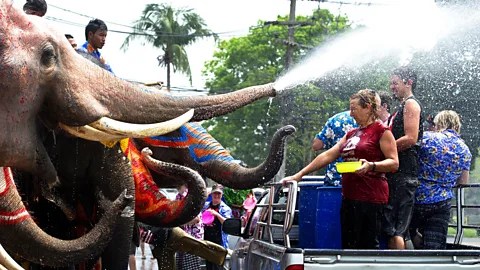
There’s a Thai word that keeps popping into my mind at the moment: Sanuk. It usually translates as “fun”, but more than that. It’s about finding joy, yes, not just in the happy moments, but also how we meet life when the going gets tough.
Cue Bangkok airport back in a lifetime or two ago. I was on my way back to the UK, asked airport staff where my flight was going from as I couldn’t see it on the board. They pointed vaguely, laughed behind their hands and whispered “Sanuk!” to each other. I noted it, intrigued and nonplussed.
Minutes later I discovered my flight was delayed by twelve hours. I’d already checked in. I couldn’t leave. There was nowhere to sleep. I did not feel very ‘sanuk’.
But the delay didn’t kill me. I chatted to other stranded passengers and complained a bit, obviously. Then we shared snacks. Got food vouchers. Compared notes. Somewhere along the way it stopped being a disaster and turned into a strange little adventure. Trapped overnight in an airport with people who were suddenly companions rather than inconveniences.
That’s when sanuk clicked. Not “this is great”.
More “this is happening, so let’s not suffer twice”.
There’s another Thai phrase that pairs beautifully with it: mai pen rai meaning ‘It doesn’t matter. Never mind. No skin off my nose.’
The thing is, we plan because planning helps. I like a plan. You probably like a plan. But the best laid plans are very often scuppered by happenstance. A delay. A curveball. A diagnosis. A moment that changes everything.
When we try to control every outcome, we end up living under constant duress. Tight. Braced. Waiting for life to behave. And life, as it turns out, generally has other ideas.
What sanuk offers is a different stance. Not resignation, and definitely not pretending things are fine, but curiosity. Meeting what shows up with a bit of flexibility, a bit of humour, and a lot of self-compassion.
I’ve felt this at both ends of the spectrum. From mild annoyances like missed trains, to life-altering moments, like being in hospital with my daughter when she was seriously ill. That was a crisis by any measure, and yet inside it there was a strange clarity. A sense of being exactly where I needed to be. Fully engaged. Focused. Knowing I could cope. The closeness it created between us was intense and real.
It turns out you can feel grounded, even happy, in the middle of something hard, not because it’s pleasant, but because you’re present and connected.
Sanuk doesn’t remove difficulty. It keeps us in relationship with it.
The sad, the bad, and the mad still show up. Plans still go sideways. Life still refuses to be tidy. But when we stop fighting that, something shifts. We suffer less. We connect more. We find moments of joy in places we didn’t expect.
From airport delays to hospital rooms, sanuk is a good companion to bring along.
Not because it makes things easy, but because it keeps us human while we’re finding our way through.
Mai pen rai.
 Katherine Mengardon
Leave a comment